1
EligibilityReview
The Society confirms the applicant’s authority over the property, the suitability of the site, and the proper scope of inquiry.

The protocol carries each audit through six stages, from eligibility review to the entry of a determination in the registry. A typical audit takes about two weeks, including a one- or two-day site visit.
1
The Society confirms the applicant’s authority over the property, the suitability of the site, and the proper scope of inquiry.
2
Investigators assemble the property’s documentary history, architectural conditions, prior testimony, local ghost-lore, and present social use.
The dossier distinguishes documented history from later folklore without treating either as irrelevant to the life of the site.
3
Investigators record the material and environmental conditions against which unusual events must be evaluated.
Baselines may include temperature curves, lighting angles, air movement, acoustic behavior, mechanical systems, sight lines, room functions, and patterns of occupation.
4
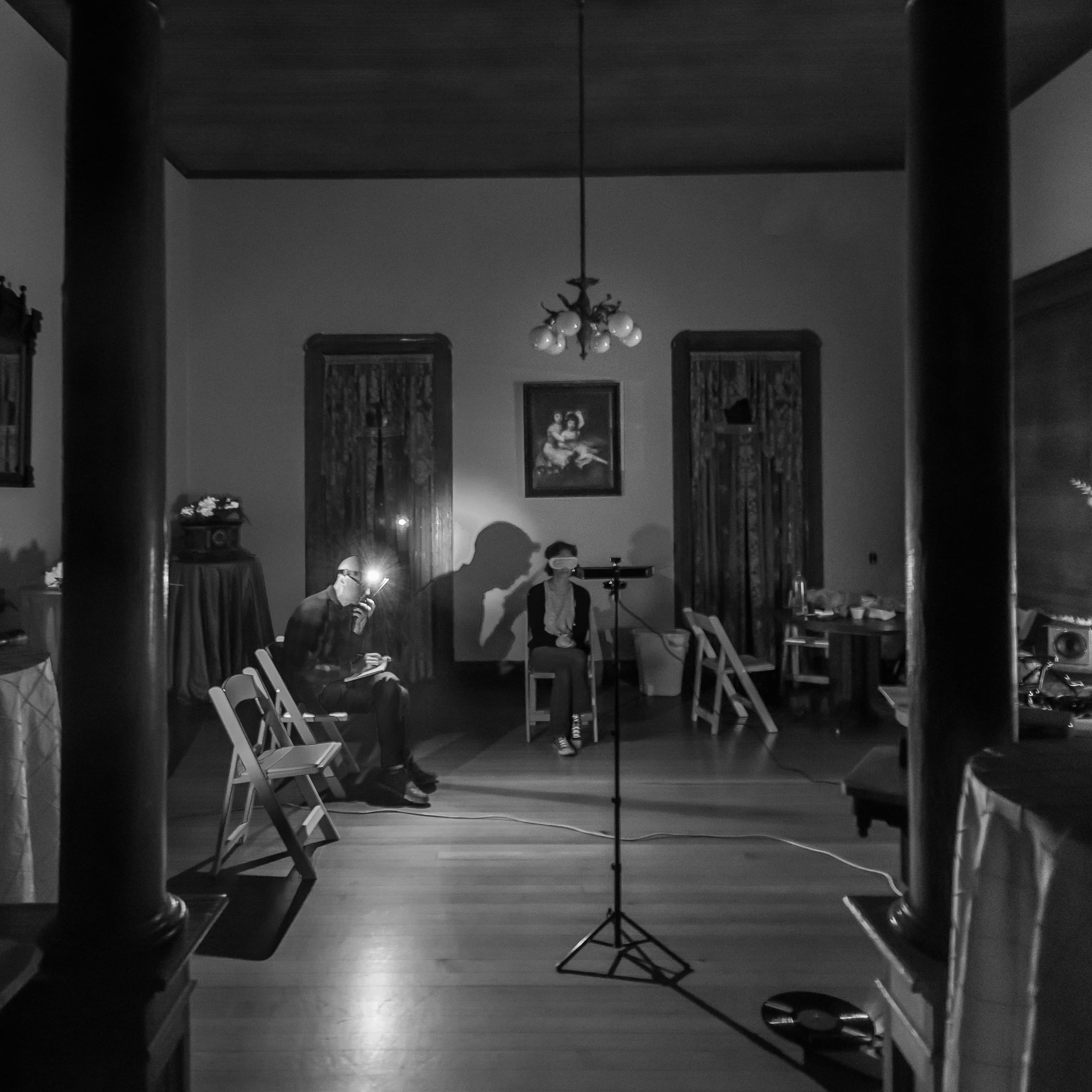
Investigators observe the site under a defined protocol, introducing controlled provocations where the method calls for them.
Investigators account for their own presence as a source of noise, expectation, and possible provocation. Every event is recorded within that reflexive frame.
5
The Society examines the record for correspondences, recurrent anomalies, alternative explanations, and evidence of an independently acting presence.
A positive spectral determination requires more than an unexplained incident. The record must show recurrence and coherence and withstand the Society’s secondary review.
6
A qualifying property receives a numbered certificate, a findings report, and an entry in the Society’s public registry.
Modes of inquiry
The Society’s broader investigation protocol distinguishes among the search for material traces, the disciplined observation of a scene and its participants, the deliberate cultivation of psychical receptivity, and the controlled provocations that invite a site to answer. The essays below examine the different modes employed in an investigation.